
Opening your page…
You can still use the navigation while it loads.
Opening your page…
You can still use the navigation while it loads.
Intercultural Practice and Equity · Internal leadership
Asking people what they think of a finished plan is not co-design, and unpaid expertise is not a partnership. Four lessons on opening a decision early, paying for the work, sharing decision rights, and writing an engagement plan people can hold you to.
40–45 minutes · 4 lessons · Voluntary learning
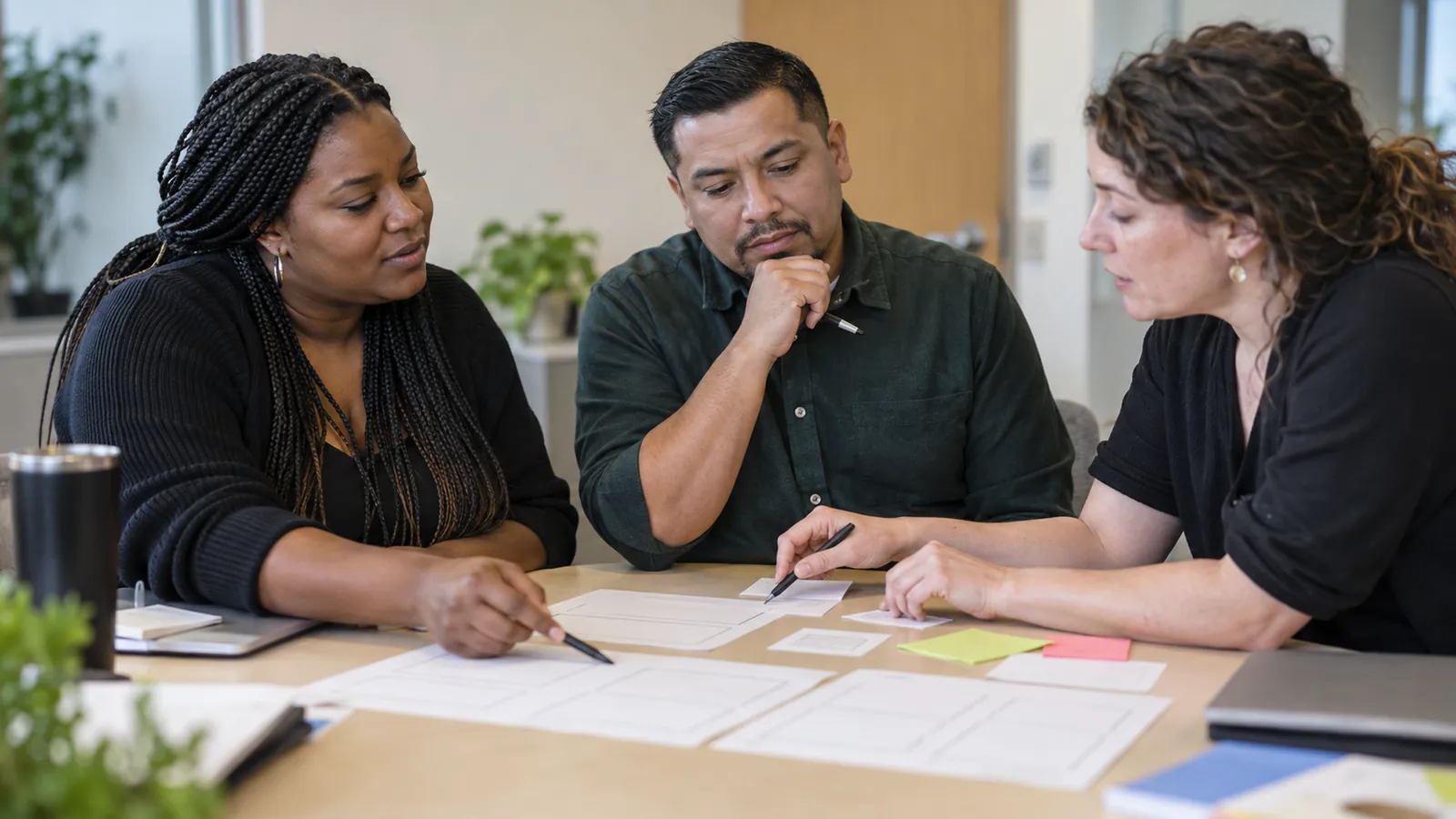
Inform, consult, involve, co-design. One question separates them, and mislabeling the level costs more trust than telling people plainly what is fixed.
Budget before you invite. The fee covers preparation and review as well as the meeting, and participation costs are the division's to carry, not a test of who can afford to help.
Ambiguity about authority is read as power and then felt as its absence. Write the authority sentence, notice who your design keeps out, and close the loop in writing with a date on it.
One page you would be willing to send to the people you are inviting: what is open, who shapes it, the terms, the decision rights, and how you will know it was real.
Choose one decision your team owns that has not been framed yet. Write two short lists — what is genuinely open, and what is fixed and why. Price the engagement, including preparation, review, travel, care, interpreting and formats. Then take the one-page plan to the person who owns the decision, before any invitation is drafted.
Most divisions already talk with people outside them. Public comment, advisory councils, listening sessions, a standing meeting with advocacy organizations. The work is real, and almost none of it is co-design. Co-design means the people most affected by a decision help set what the question is, what the options are, and what a good result would look like, before the division's own preferences have hardened — and it means paying them for that work the way any other expertise is paid for. This module covers the four levels of partnership and the single question that separates them, how to price and route compensation so an invitation is not a request for free labor, how to state what authority a group actually holds and close the loop when the division goes a different way, and how to put all of it on one page you would be willing to send to the people you are inviting.
If you would not send the engagement plan to the people you are inviting, it is not finished.
Keep the four levels, the true cost of participation and the authority sentence in view while you plan, price, defend or repair an engagement with people outside the division.
Fill in the one-page engagement plan for one decision your team owns, and take it to the person who owns that decision before any invitation is drafted.
Participation and course completion in this program do not count toward DHS-required training credits unless management, a director, or DHS leadership expressly approves an exception.
Guidance on bringing people with disabilities into a project early rather than at review, why late involvement produces repairs instead of design, and how to arrange and compensate that participation.
National standards for culturally and linguistically appropriate services, including the governance, leadership and community-engagement standards on partnering with communities to design, implement and evaluate services.
The state's grants policies, statutes and forms — the practical route for paying a community organization for staff time, facilitation, translation or recruiting rather than asking for it unpaid.
The state's financial management agency, whose statewide financial and payment policies shape how payments to individuals and organizations are set up, routed and timed.
Minnesota's advisory council on disability policy, access and rights, and a standing route for connecting with disability-led organizations across the state.
U.S. Department of Justice guidance on what a state or local government must provide, including effective communication and accessible programs, services and activities — the floor an engagement has to meet before it can be called open.
Guidance on audience, organization and useful headings, applied here to invitations, session materials and the report-back that tells people what happened to their contribution.
The design reference for this curriculum: multiple ways to engage, culturally responsive materials, and accessible instruction that does not depend on one format or one pace.