
Opening your page…
You can still use the navigation while it loads.
Opening your page…
You can still use the navigation while it loads.
DSD Service System · Practice
Presuming competence, the methods people use to communicate when speech is not available or not enough, what it takes to work with an interpreter or a communication device well, and how to make what you say and write usable.
50–55 minutes · 5 lessons · Voluntary learning
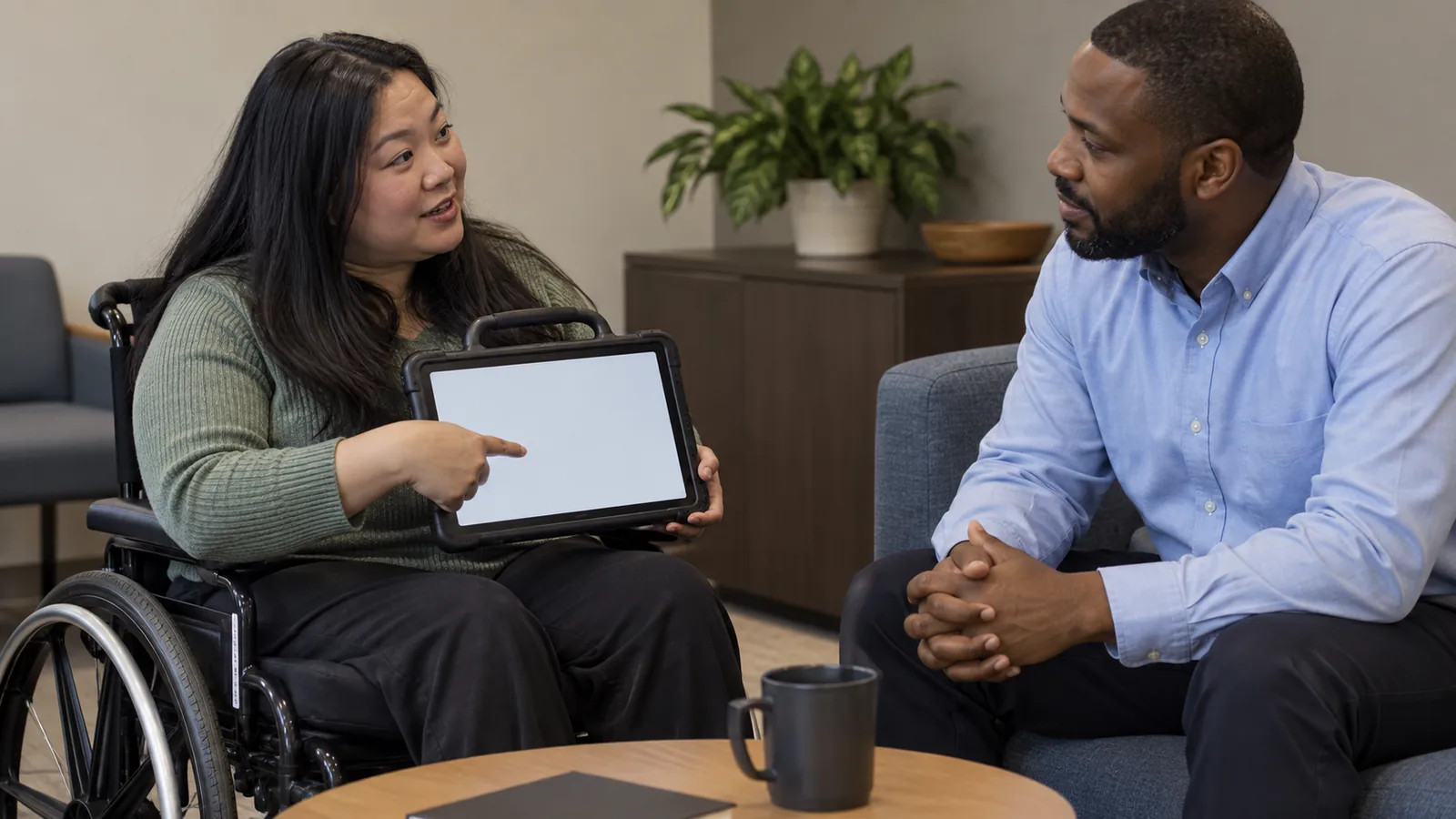
Start from the assumption that the person understands and has something to say, and see what changes when you do.
Meet the main methods people use when speech is not available or not enough, and what each requires of the listener.
Work with a sign language or spoken language interpreter in a way that keeps the person as the party to the conversation.
Support a person who uses a communication device without speaking for them, finishing their sentences, or filling their silence.
Review one interaction for communication access and produce one change.
In your next conversation with a person who uses a method other than spoken English, wait twice as long as feels comfortable before speaking again.
Communication is where a service either meets a person or misses them entirely. Many people served by the Division do not use spoken English as their main method: they sign, they use a device, they point, they type, they use a language other than English, or they communicate through behavior that someone has to learn to read. This module covers the assumption that has to come first, the methods people use, what it takes to work with an interpreter or a device well, and how to make what you say and write usable by the person in front of you. Nothing here is scored, ranked or collected.
Not speaking is a fact about method. It is not evidence about understanding.
Start from the assumption that the person understands, learn their method, keep the conversation with them, wait, and make sure they leave with something they can use.
Run the communication-access review on one interaction and change one thing about the next.
Participation and course completion in this program do not count toward DHS-required training credits unless management, a director, or DHS leadership expressly approves an exception.
Department information on interpreter services and alternative formats.
State commission with guidance on communication access for Deaf, DeafBlind and hard of hearing Minnesotans.
Public information on augmentative and alternative communication methods and supports.
Professional standards for sign language interpreters, including working with interpreters.
Guidance on the effective communication obligations of public entities.
State council offering guidance and technical assistance on disability access and policy in Minnesota.