
Opening your page…
You can still use the navigation while it loads.
Opening your page…
You can still use the navigation while it loads.
Disability Inclusion · Applied inclusion
Adapt how you communicate for Deaf and hard-of-hearing people, people with speech disabilities, blind and low-vision people, people with cognitive disabilities and people with anxiety, without patronizing anyone.
45–55 minutes · 5 lessons · Voluntary learning
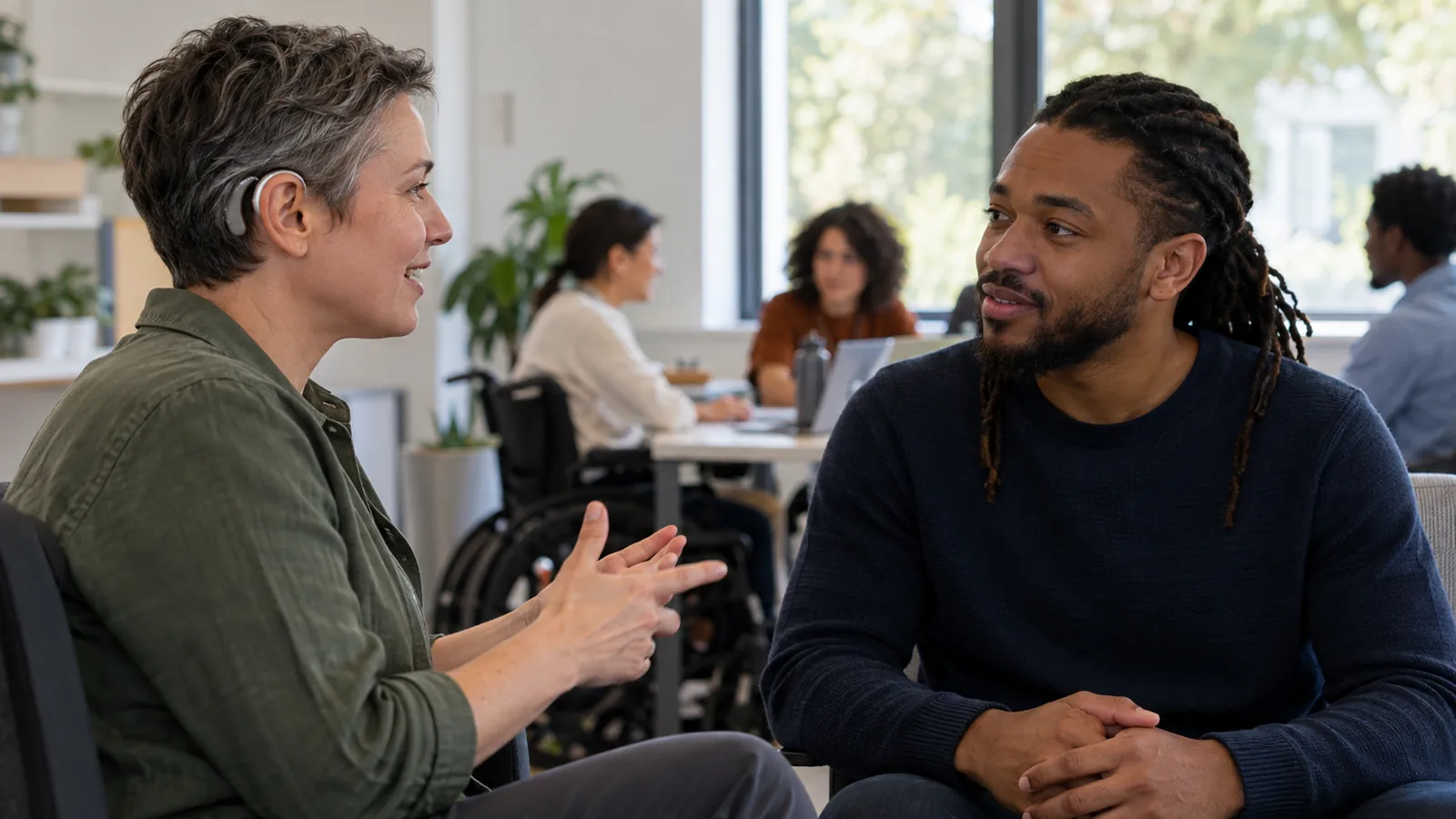
Learn the habits that help across disabilities, and the tone that undoes them.
Arrange real communication access, know the difference between an interpreter, captioning and relay, and stop asking family members to interpret.
Give time, stop finishing sentences, and keep the person on the line instead of handing them off.
Give written information in the format the person chooses, describe instead of pointing, and stop building visual-only steps into your process.
Break information into steps, give a predictable process and written expectations, and know what to do when a conversation stops working.
Pick the lesson closest to your daily work. Use its practice in your next three conversations of that kind, and tell a colleague what changed for the person and for you.
Communication is where access is won or lost in most human-services work: the phone intake, the interview, the notice, the planning meeting. This course gives you a small set of habits that work across disabilities, then goes deeper into five situations staff meet every week: a Deaf applicant who needs communication access for an interview, a person with a speech disability being rushed on the phone, a participant with low vision facing a visual-only form, a person with a cognitive disability who needs information in smaller steps, and an employee with anxiety who asks for a predictable meeting process. Each lesson ends with one practice you can use the same day.
Ask how. Give time. Write it down. Talk to the person. When it breaks, repair it.
Keep the practices from each lesson in reach during a real call, interview or planning conversation.
Choose the lesson closest to your work and use its practice in your next three conversations.
Participation and course completion in this program do not count toward DHS-required training credits unless management, a director, or DHS leadership expressly approves an exception.
The requirement that public entities communicate as effectively with people with disabilities as with others, with primary consideration to the person's requested aid or service, and cautions about relying on companions to interpret.
Guidance and training on communication access, auxiliary aids and services, and ADA obligations for state and local programs.
Accessibility fundamentals for digital documents and forms, including text alternatives, headings, labels and not relying on color alone.
Practical guidance on creating accessible electronic documents and content.
Accommodation ideas for communication, cognitive and mental-health-related access needs in the workplace, including predictable processes and written instructions.
Minnesota resource for access questions, including communication access and alternative formats in state and local services.